
Why Modern Businesses Are Moving Beyond Disconnected Security Systems
Security system integration is the process of combining multiple security technologies—like access control, video surveillance, alarms, and building automation—into a single, unified platform that communicates seamlessly and can be managed from one central location.
Quick answer for anyone searching “Security system integration”:
- What it is: Connecting separate security systems (cameras, door locks, alarms, fire safety) into one coordinated network.
- Why it matters: Provides real-time visibility, automated responses, and eliminates costly gaps between disconnected systems.
- Key benefit: Manage everything from one dashboard instead of juggling multiple separate platforms.
- Who needs it: Any business concerned about security gaps, operational efficiency, or managing complex facilities.
If your business security grew piece by piece—an alarm system here, cameras there, then electronic door locks—you’ve likely created a collection of systems that don’t talk to each other. This creates dangerous blind spots. When an alarm triggers, does your camera automatically record the event and send you a video alert? With disconnected systems, the answer is usually no.
These gaps have real costs. Property crime results in over $15.8 billion in losses annually in the U.S., while evolving cyber attacks are also on the rise. This is why over 60% of modern organizations have moved to converged security systems. They recognize that isolated systems are no longer enough.
Integration solves this by creating an intelligent ecosystem. Instead of separate components working in isolation, one event triggers coordinated, automated responses across your entire security infrastructure, creating a stronger, more responsive defense.
The Building Blocks: Core Components of an Integrated System
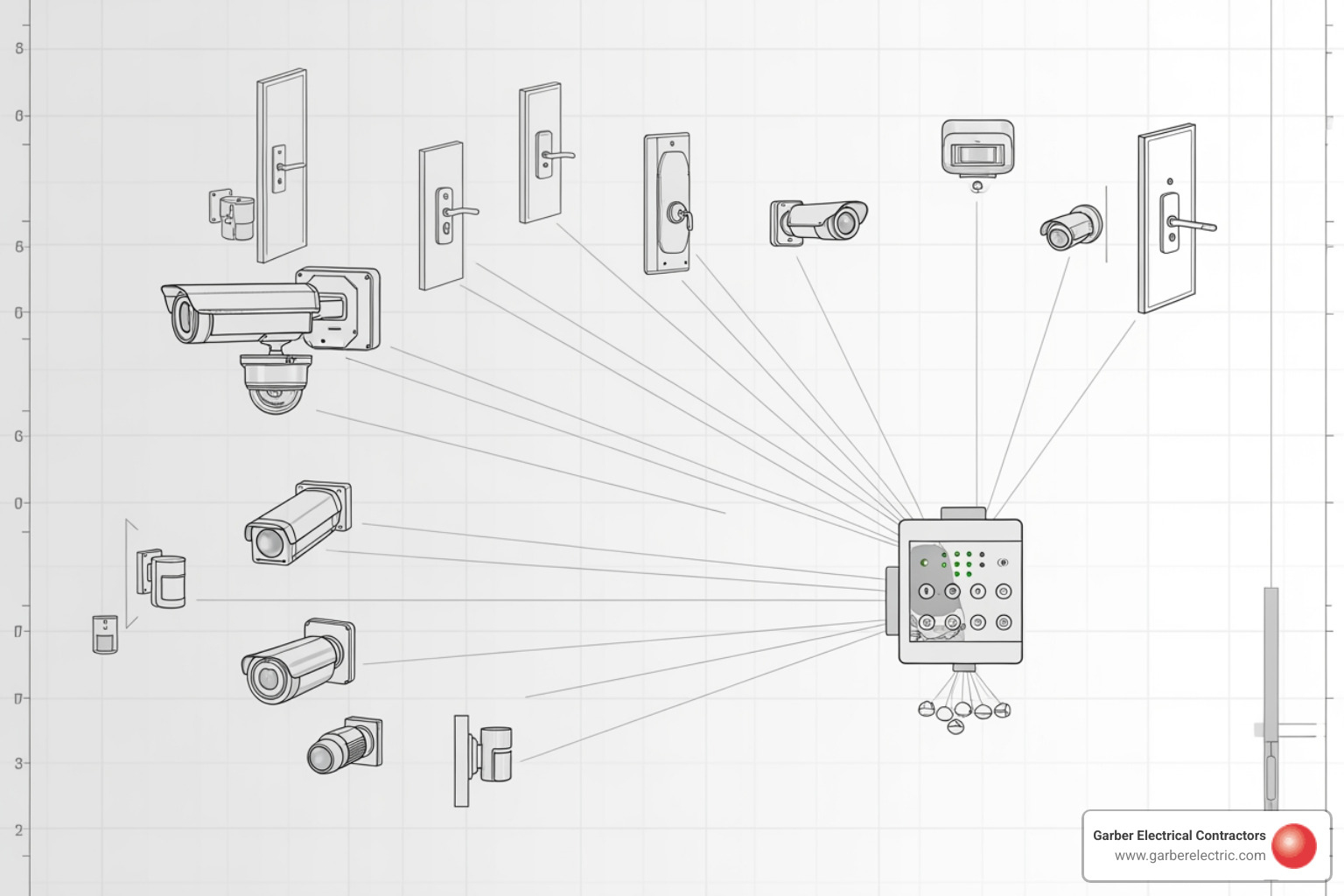
Think of security system integration like an orchestra: each instrument is powerful on its own, but together they create something far greater. When your security systems are conducted from a single platform, they transform from isolated guards into a coordinated team.
What Systems Can Be Combined?
Nearly any electronic security or building system can be integrated. For businesses in Dayton, Columbus, or anywhere in the Miami Valley, these are the core components we bring together:
- Access Control: Smart locks, card readers, and biometrics that can trigger cameras, send alerts, and control entry.
- Video Surveillance: IP cameras and CCTV systems that provide visual verification and can be triggered by other system events.
- Intrusion and Burglar Alarms: Your first line of defense, which can automatically lock doors, activate cameras, and notify authorities.
- Fire and Life Safety: Fire alarms and sprinklers connected to your Mass Notification and Security system to coordinate emergency responses and guide evacuations.
- Building Automation: HVAC and lighting systems that adjust based on occupancy data from access control, saving energy and enhancing security.
- Visitor Management: Digital check-in systems that issue temporary credentials and track guests for complete visibility.
- Intercoms and Communication: Systems that allow remote communication and entry control, integrated with access and video.
How Security System Integration Works
Modern technology makes it simple for these diverse systems to communicate.
The Internet of Things (IoT) provides the foundation, with connected devices constantly exchanging information in real-time. Everything is managed through centralized management software—a single dashboard that acts as the brain of your entire security operation, coordinating automated responses.
This communication happens via APIs and protocols, which act as translators between different software. We design systems using open standards to ensure compatibility and prevent vendor lock-in. You can choose between flexible cloud-based platforms for remote access and scalability, or on-premise servers for maximum local control.
For example, when an unauthorized card is used at your Columbus facility, the door remains locked while an instant alert with live video is sent to security. The system logs the failed attempt and can track the individual’s movement. This is the power of Integrating Commercial Surveillance and Automated Security: one action triggers multiple, coordinated responses.
Open uping Value: The Strategic Benefits of an Integrated Approach
Moving to a fully integrated ecosystem is a strategic investment that transforms how you protect your business, streamline operations, and reduce costs. It’s the difference between individual guards working alone and a coordinated team with shared intelligence.
Improved Security and Situational Awareness
Integration provides a complete, real-time picture of your facility’s security. Instead of juggling multiple applications, your team uses a centralized monitoring dashboard to see everything at once. When an event occurs, real-time alerts provide rich context—like video footage paired with an access control log—allowing for faster, smarter decisions.
The biggest advantage is automated responses. An alarm can instantly lock doors, activate lights, and notify personnel without human intervention. This reduces reaction time and eliminates errors during critical moments. When investigating an incident, all related data (video, access logs, alarms) is linked and easily accessible, speeding up the process and providing verifiable evidence.
Improved Operational Efficiency and Cost Savings
An integrated system doesn’t just improve security—it can save you money. Streamlined management from a single platform frees up your staff from tedious administrative work. Routine tasks like locking doors at closing time or generating daily reports can be fully automated, ensuring consistency and reducing labor costs.
One of the most significant benefits is energy savings from smart building control. By integrating with HVAC and lighting, your security system can use occupancy data to reduce energy waste by up to 40%. Overall, businesses often see 25-35% operational cost reductions from the automation and optimization that integrated systems provide. The long-term savings from solutions like cost-effective access control systems often outweigh the initial investment.
Simplified Compliance and Risk Management
Integrated systems make navigating compliance and audits significantly easier. Automated audit trails log every event, creating a comprehensive, tamper-proof record for regulatory reporting. This eliminates the manual effort of compiling data from separate systems.
This verifiable evidence is also your best defense against false claims. With insurance fraud costing U.S. organizations $308.6 billion annually, having integrated video, access, and alarm data can quickly disprove fraudulent workers’ compensation or liability claims. For businesses in Dayton, OH, proper system maintenance is key to ensuring this evidence is reliable, which helps protect your business from liability claims.
The Future is Now: Technology’s Role in Modern Security System Integration
Today’s security system integration is powered by technologies that are making security more intelligent, predictive, and intuitive. These innovations are changing what’s possible for businesses in Dayton, Columbus, and beyond.

The Power of AI, IoT, and Cloud Computing
Artificial intelligence, the Internet of Things (IoT), and cloud computing are turning traditional security systems into proactive partners.
AI-powered video analytics allow cameras to understand what they see, detecting loitering, abandoned objects, or license plates. Instead of security staff watching endless footage, the system alerts them when an event requires attention. AI can even perform predictive analysis, identifying vulnerabilities by analyzing data patterns from access logs and alarms before they can be exploited. When looking for Top Features to Look For in Surveillance Systems, AI should be a priority.
Cloud computing offers the flexibility to manage your entire system from anywhere via a smartphone or tablet. It also makes your system highly scalable, allowing you to easily add new devices as your business grows. This is complemented by the evolution of access control, where biometrics and mobile credentials are replacing keycards for improved security and convenience.
Bridging the Gap: Physical and Cybersecurity Convergence
For years, physical security (locks and cameras) and cybersecurity (firewalls and passwords) operated in separate silos. In today’s connected world, this separation is a major liability. Every networked camera, smart lock, and sensor is both a physical asset and a potential entry point for cyber threats.
Security system integration bridges this gap by creating a unified defense. A converged system allows for shared threat intelligence; a cyber alert can automatically trigger physical protocols like locking down a server room, while a physical breach attempt can notify the IT team. This holistic approach is now a business necessity, with over 60% of organizations operating converged security systems.
Of course, every interconnected device must be secured with robust authentication and encryption. This is why a reliable network foundation, supported by services like structured cabling, is critical. The future of security is not about building higher walls between physical and digital, but tearing them down to create a single, resilient security posture.
Finding Your Partner: How to Choose a Security Integrator
Starting on a security system integration project requires a partner who understands your unique business needs and can deliver a solution built for long-term value. Choosing the right integrator is a strategic decision that will determine the success of your security investment.
Key Services to Expect
A professional integrator offers more than just installation. Whether you’re in Lewis Center or Dayton, you should expect a comprehensive approach:
- Security Risk Assessment: A thorough evaluation of your facility to identify vulnerabilities and define your specific security needs.
- System Design and Engineering: Creating a customized, scalable blueprint that selects the right technologies and maps out how they will work together.
- Professional Installation: Meticulous installation and calibration of all hardware and software. Understanding the benefits of professional installation is key to avoiding future issues.
- Staff Training: Ensuring your team is confident and capable of operating the new integrated system effectively.
- Ongoing Maintenance and Support: Proactive service to keep your system updated and running smoothly, which is essential for businesses.
What to Look For in an Integrator
Not all integrators are created equal. Here are the key qualities that separate the exceptional from the adequate:
| Quality | What to Look For |
|---|---|
| Industry Experience | A proven track record in your specific industry. An experienced integrator understands the unique threats and regulations you face. |
| Technical Expertise | Certifications from major manufacturers and industry organizations, demonstrating a commitment to current best practices. |
| Vendor Partnerships | Strong relationships with leading security manufacturers, which can lead to better pricing, support, and access to innovation. |
| Reputation and References | A willingness to provide references from satisfied clients. Don’t just take their word for it—ask to speak with other businesses. |
| Scalability of Solutions | A focus on designing systems that can grow with your business without requiring a complete and costly overhaul. |
| Commitment to Service | A long-term partnership approach with clear service agreements and responsive support for when you need it most. |
For businesses throughout Ohio, Kentucky, and Indiana, finding a partner who offers “One Company Many Solutions” ensures that your electrical, surveillance, and access control needs are handled seamlessly by one trusted source.
Introduction: From Security System Integration
Why Modern Businesses Are Moving Beyond Disconnected Security Systems
Security system integration is the process of combining multiple security technologieslike access control, video surveillance, alarms, and building automationinto a single, unified platform that communicates seamlessly and can be managed from one central location.
Quick answer for anyone searching “Security system integration”:
- What it is: Connecting separate security systems (cameras, door locks, alarms, fire safety) into one coordinated network
- Why it matters: Provides real-time visibility, automated responses, and eliminates costly gaps between disconnected systems
- Key benefit: Manage everything from one dashboard instead of juggling multiple separate platforms
- Who needs it: Any business concerned about security gaps, operational efficiency, or managing complex facilities
If your security grew piecemeal, you likely have systems that dont talk to each other, creating blind spots and slow responses. Property crime accounts for about $15.8 billion in losses annually in the U.S., and over 60% of modern organizations now operate converged security systems to close those gaps.
Integration turns isolated components into an intelligent ecosystem where one event triggers coordinated responses across your entire security infrastructure.
The Building Blocks: Core Components of an Integrated System
When your systems work together, you get faster, clearer, and more reliable protection.
What Systems Can Be Combined?
- Access Control: Smart locks, cards, biometrics that trigger cameras, alerts, and entry logic
- Video Surveillance: IP/CCTV cameras providing visual verification linked to events
- Intrusion/Burglar Alarms: First-line alerts that can lock doors and notify teams
- Fire and Life Safety: Alarms and sprinklers that tie into Mass Notification and Security for coordinated emergency response
- Building Automation: HVAC/lighting that adjust with occupancy for security and energy savings
- Visitor Management: Check-in, temporary credentials, and visibility
- Intercoms/Communication: Remote communication and entry control integrated with access and video
How Security System Integration Works
- IoT devices share data in real time
- Centralized management software unifies monitoring and automations
- Open APIs and protocols ensure compatibility and avoid vendor lock-in
- Cloud platforms enable remote access and easy scaling; on-prem servers offer maximum local control
Example: A denied badge swipe can keep the door locked, pivot a nearby camera to record, and alert security with live video. This is the power of Integrating Commercial Surveillance and Automated Security.
Open uping Value: The Strategic Benefits of an Integrated Approach
Integration lifts protection, simplifies operations, and reduces costs.
Improved Security and Situational Awareness
- Centralized monitoring gives a complete, real-time view
- Rich, real-time alerts combine video, access logs, and location
- Automated responses lock doors, activate lights, and notify staff instantly
- Faster investigations with linked video, access, and alarm data
- For outdoor coverage, see why outdoor surveillance is key for protecting your business
Improved Operational Efficiency and Cost Savings
- Streamlined, single-platform management reduces administrative load
- Automate routine tasks like scheduled locking and reporting
- Integrate HVAC/lighting with occupancy data to cut wasteresearch suggests up to 40% energy waste reduction is possible
- Operational savings and the cost-effectiveness of access control systems often outweigh upfront costs
Simplified Compliance and Risk Management
- Automated audit trails simplify reporting and strengthen controls
- Integrated evidence helps combat false claimsinsurance fraud costs U.S. organizations an estimated $308.6 billion annually per the Insurance Information Institute (III)
- Proper maintenance ensures reliable evidence: how proper CCTV system maintenance helps protect your Dayton business from liability claims
- Easier alignment with regulations (HIPAA, PCI, and more)
The Future is Now: Technology’s Role in Modern Security System Integration
Modern integration uses AI, IoT, and cloud to turn security into a proactive, data-driven partner.
The Power of AI, IoT, and Cloud Computing
- AI video analytics detect critical events (loitering, objects, license plates) and reduce monitoring fatigue; see Top Features to Look For in Surveillance Systems
- Predictive insights from patterns in access, alarms, and sensors help fix vulnerabilities before incidents
- Cloud management enables anywhere control and easy scaling across sites
- Access control is evolving with biometrics and mobile credentials: The Future of Access Control in Dayton OH: Biometrics, Mobile Credentials & More
Bridging the Gap: Physical and Cybersecurity Convergence
- Unified defense shares intelligence: cyber alerts can lock down server rooms; physical breaches can alert IT
- Secure every device with strong authentication, encryption, and updates
- A resilient network foundation matters: Why Growing Columbus Businesses Should Prioritize Structured Cabling Services
- Work with integrators who understand both domains to mitigate new vulnerabilities
Finding Your Partner: How to Choose a Security Integrator
The right integrator designs, deploys, and supports a solution custom to your risks, workflows, and growth.
Key Services to Expect
- Security risk assessment and site survey
- Custom system design and engineering
- Professional installation and calibration (see Top Benefits of Professional Access Control Installation)
- Staff training for confident daily use
- Ongoing maintenance, updates, and responsive supportWhy Regular Commercial Security Camera Maintenance is Essential for Englewood OH Businesses
What to Look For in an Integrator
| Quality | What to Look For |
|---|---|
| Industry Experience | Proven results in your sector and familiarity with its risks/regulations |
| Technical Expertise | Current certifications and mastery of leading platforms |
| Vendor Partnerships | Strong manufacturer ties for pricing, support, and innovation access |
| Reputation and References | Willingness to share references from similar local clients |
| Scalability of Solutions | Designs that expand without rip-and-replace |
| Commitment to Service | Clear SLAs, proactive maintenance, and long-term support |