
Why Energy Security Matters More Than Ever
Home power solutions are systems that provide electricity to your residence, either as a backup to the main grid or as a primary source. They range from standby generators and solar power with battery storage to emerging technologies like Vehicle-to-Home (V2H) charging.
Quick Overview of Home Power Solutions:
- Generators – Automatic backup power using natural gas, propane, or diesel fuel
- Solar + Battery Systems – Capture sunlight and store excess energy for later use
- Vehicle-to-Home (V2H) – Use your electric vehicle’s battery to power your home
- Hybrid Systems – Combine multiple technologies for maximum reliability
If you live in Ohio’s Miami Valley region, you know the challenge of unpredictable weather. Ice storms and summer thunderstorms can knock out power for days, leaving your family in the dark.
The numbers confirm a growing trend: the global home energy storage market is projected to reach $35.8 billion by 2030. Homeowners are realizing that relying solely on an aging grid, strained by increased demand and rising electricity costs, is a significant risk.
The good news is that you have options. Modern home power solutions offer backup power, cost savings, and energy independence. Whether you need to keep critical systems running during an outage, want to slash your monthly bills with solar, or desire complete energy independence, there’s a solution for your needs and budget.
This guide breaks down everything you need to know about home power solutions, helping you understand how each system works, what it costs, and how to choose the right one for your home.
The Benefits of Investing in Energy Independence
No one thinks about their power supply until it’s gone. But home power solutions offer benefits that extend far beyond just keeping the lights on during a storm.
Backup power during outages is the most obvious advantage. When storms roll through the Miami Valley, your home stays powered. Your refrigerator, sump pump, and other essential systems keep running, providing invaluable peace of mind. If you’ve lived through Ohio’s unpredictable weather, you know how critical this is. We’ve seen this with families in our area—check out our guide on Why Columbus Ohio’s Unpredictable Weather Makes Home Standby Generators a Smart Investment.
Beyond backup, many solutions deliver real cost savings on electricity bills. Solar and battery systems allow you to generate your own power or store energy during cheaper off-peak hours, reducing what you pay the utility company each month.
This leads to a greater sense of energy independence and control. You’re no longer completely at the mercy of utility rate hikes or grid instability. When the grid goes down, your power stays on. It’s hard to put a price on that control over your own energy future.
For those focused on environmental sustainability, options like solar power reduce your carbon footprint by generating clean energy. It’s a way to protect your family, save money, and do your part for the planet.
Finally, these systems can increase your property value. A home with a standby generator or solar system is a serious upgrade that appeals to modern buyers, who recognize the value of security and lower operating costs. It’s an investment that pays off when it’s time to sell.
Energy independence isn’t just about surviving an outage. It’s about taking control of your home’s future, saving money, and gaining the peace of mind that comes from being prepared.
Exploring the Main Types of Home Power Solutions
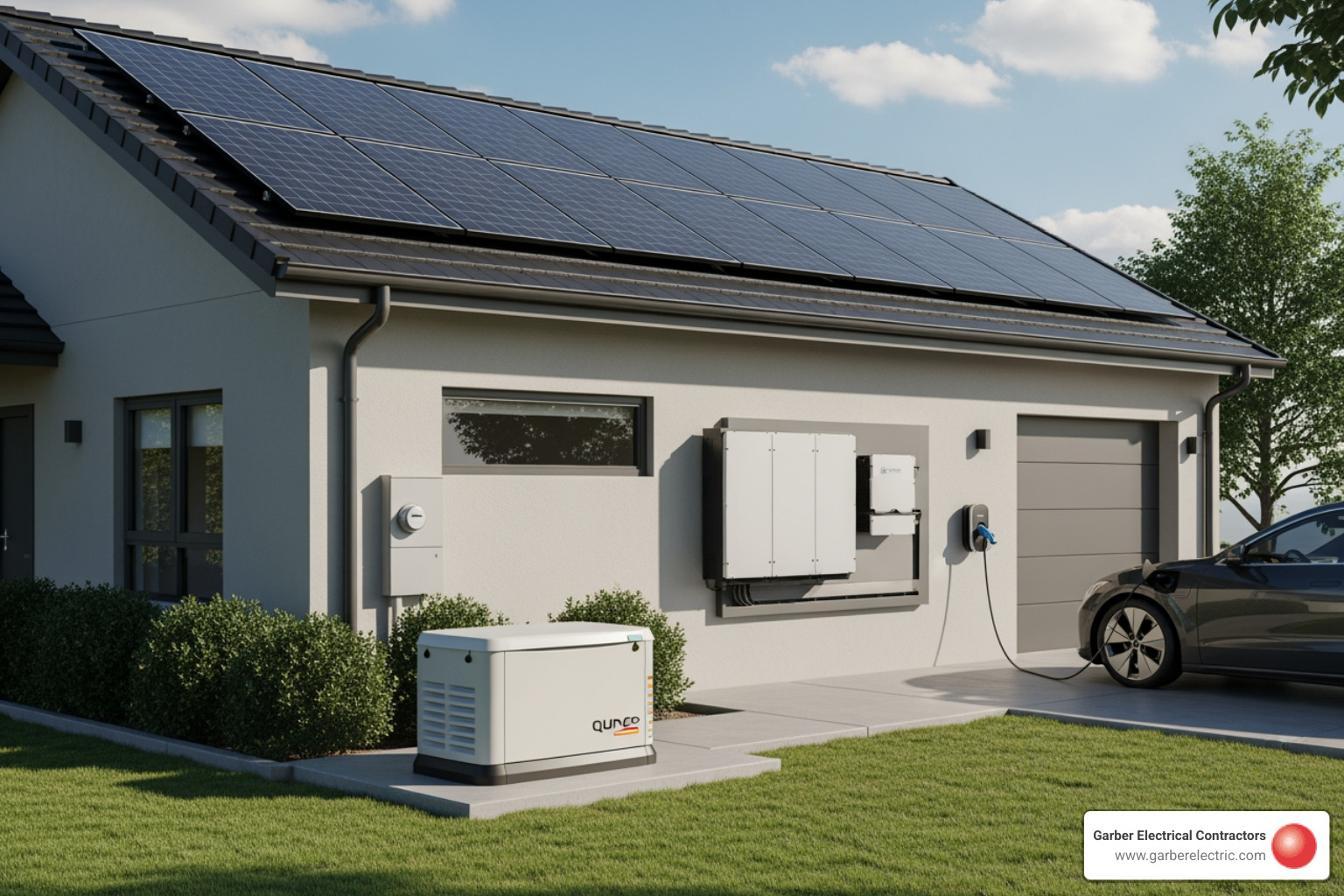
You have more options than ever for powering your home. There’s no single “best” choice, just the right fit for your needs and budget. Let’s walk through the main types of home power solutions.
| Feature | Generators | Solar + Battery | V2H (Vehicle-to-Home) |
|---|---|---|---|
| Upfront Cost | Moderate to High | High | Moderate (if you already own a compatible EV) to High |
| Running Cost | Fuel costs (natural gas, propane, diesel) | Low (sunlight is free) | EV battery recharge cost (electricity) |
| Reliability | Very High (automatic, fuel-dependent) | High (weather-dependent for charging, battery for storage) | High (EV battery capacity, vehicle availability) |
| Environmental Impact | Moderate (emissions from fuel combustion) | Low (clean energy, reduced carbon footprint) | Low (clean energy from EV battery) |
| Maintenance | Regular (oil changes, filter checks, fuel storage) | Low (panel cleaning, occasional inverter checks, battery monitoring) | Low (EV maintenance, charger checks) |
Dependable Power: Whole-House and Standby Generators
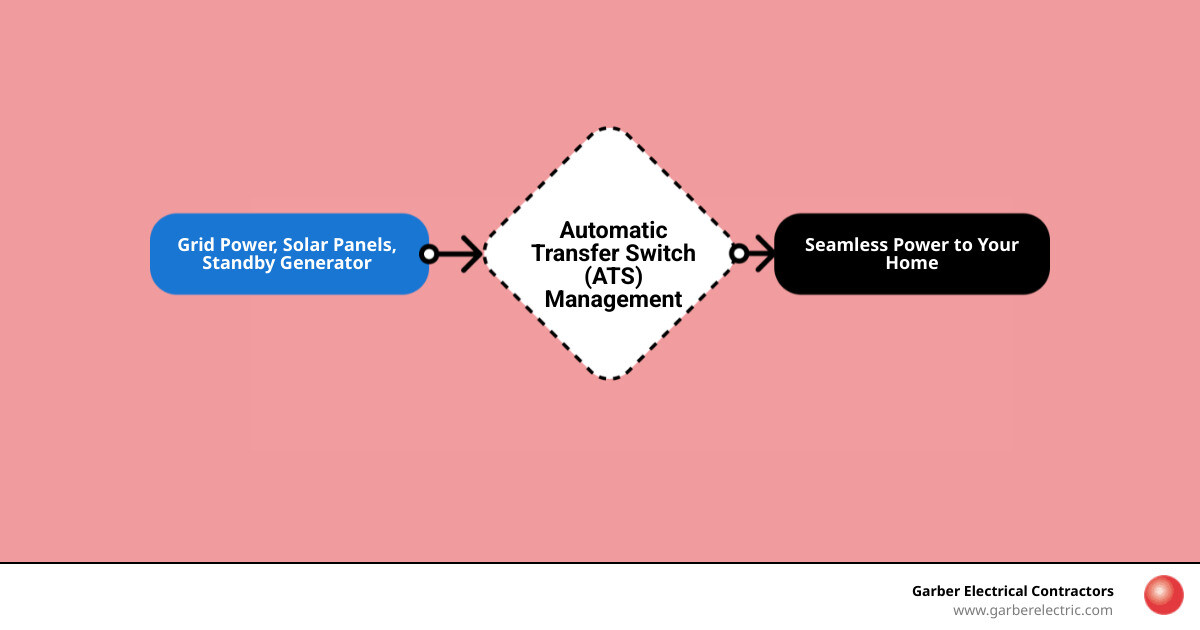
When the power goes out, a whole-house standby generator keeps your lights on and your furnace running. These units are permanently installed outside your home and work automatically. When grid power fails, an Automatic Transfer Switch (ATS) detects the outage, starts the generator, and seamlessly transfers your home’s power source. When utility power returns, the process reverses. You don’t lift a finger. Learn more in our guide on Whole House Generators: How They Work & Why You Need One.
Generators run on different fuel types. Natural gas offers a virtually unlimited supply from your home’s gas line. Propane is stored in large tanks that require refilling. Diesel requires its own tank and regular fuel deliveries. Our article on the Pros and Cons of a Diesel Whole House Generator can help you decide if it’s a fit.
You can choose to power only critical loads—like the refrigerator and furnace—or your whole home for complete normalcy during an outage.
Using the Sun: Solar Power Systems
Modern solar systems are sleek, efficient, and can significantly cut your utility bills. Solar panels use the photovoltaic effect to convert sunlight into DC electricity. An inverter then changes it to the AC power your home uses.
There are three main system types. Grid-tied systems, the most common setup, connect to the utility grid, allowing you to send excess power back for credits. Off-grid systems operate independently, requiring careful sizing and battery storage. Hybrid systems offer the best of both worlds, combining a grid connection with battery storage for flexibility and security.
An off-grid system’s key components include solar panels, charge controllers (to protect batteries), batteries (for energy storage), and an inverter. For more information, the Department of Energy’s Homeowner’s Guide to Going Solar is an excellent resource.
Storing Your Power: Modern Battery Systems
Battery storage gives you control over your energy. You can store excess solar energy for use at night or take advantage of time-of-use optimization by charging batteries with cheap grid power and using it during expensive peak hours.
When shopping for batteries, consider capacity (measured in kWh), which is how much energy it stores, and power output (in kW), which is how much power it can deliver at once. The popular Tesla Powerwall 2 stores 13.5 kWh, while the EcoFlow DELTA Pro Ultra can be configured from 6 to 90 kWh.
LiFePO4 (Lithium Iron Phosphate) has become the gold standard for home power solutions due to its long life and safety. While cheaper upfront, traditional lead-acid batteries don’t last as long. Many modern systems are also scalable, allowing you to add more storage as your needs grow.
The Future is Here: Vehicle-to-Home (V2H) Technology
Imagine your EV powering your home during an outage. That’s Vehicle-to-Home (V2H) technology, available now. It works through bidirectional charging, which allows power to flow from your car to your house. Your EV becomes a massive mobile battery.
The benefits are compelling. Most EV batteries have far more capacity than typical home batteries. GM Energy’s V2H-capable EVs, for example, can provide backup power for up to 21 days with reduced usage. The requirements for V2H include a compatible vehicle, a bidirectional charger, and a V2H enablement kit. This technology represents an exciting new direction for integrated home power solutions.
How to Choose the Right Home Power Solution for Your Needs
Selecting the right home power solution is a personal decision based on your home, family, and goals. Whether you’re in Dayton, Columbus, or anywhere in the Miami Valley, this step-by-step process can guide you.
Step 1: Assess Your Energy Consumption
First, understand your home’s energy appetite. Review your utility bills from the past year to find your monthly kilowatt-hour (kWh) usage and identify your average daily energy usage.
Next, identify your essential appliances. Walk through your home and list what must stay on during an outage: refrigerator, freezer, sump pump, furnace fan, and any medical equipment. These are your critical loads. Then, list desirable loads like the TV, microwave, or extra lights. This helps determine the peak demand your system will need to meet.
Step 2: Weighing Key Factors for Your Home
Once you know what you need to power, assess your property’s suitability.
- Budget and financing are a primary consideration. While these systems are an investment, many pay for themselves over time through energy savings.
- Property constraints are crucial. For solar, you need good roof suitability and sun exposure. Generators require specific yard space with proper clearance for ventilation and service access.
- Local regulations and permits vary by location. Working with an experienced local installer who understands these codes is vital. There are 3 Factors to Keep in Mind Prior to Installing a Whole House Generator, and local codes are a major one.
- Your local climate and sun hours will influence system design, especially for solar, to ensure year-round reliability.
Step 3: Sizing Your System and Understanding Costs
This is where your needs and property constraints come together to determine system size and cost.
- Generator sizing in kilowatts (kW) is based on the critical and desirable loads you identified. A smaller home might need a 14-16 kW unit, while a larger one could require 22 kW or more. Our guide on How to Choose the Right Size House Generator for Your Columbus Ohio Home explains this in detail.
- Solar array sizing in kilowatt-peak (kWp) is calculated based on your energy consumption and how much power you want to generate.
- Battery capacity sizing in kilowatt-hours (kWh) depends on how much backup time you want.
Installation costs vary with your home’s complexity, while long-term costs differ by system. Generators have ongoing fuel and maintenance expenses. Solar and battery systems have higher upfront costs but minimal ongoing expenses. Our Guide to Buying a Whole House Backup Generator breaks down these costs, because choosing a home power solution is about the total cost of ownership and long-term peace of mind.
Installation, Maintenance, and Long-Term Value
Proper installation and care are what make your home power solution a worthwhile investment. Here’s what you need to know to ensure your system serves you well for years to come.
Professional Installation: Getting It Done Right
Installing a home power solution is not a DIY project. These systems involve complex electrical work and strict safety codes. Working with certified installers like Garber Electrical Contractors ensures every connection is made correctly and safely.
A professional handles the entire process, including:
- Electrical panel integration to connect the new system to your home.
- Transfer switch installation for generators, which is critical for automatic operation and preventing dangerous backfeeding.
- The permitting process and safety inspections to ensure your system meets all local codes in Ohio, Kentucky, and Indiana.
Proper installation is the foundation of a safe and reliable system, as highlighted in our article on How Whole Home Generators Keep Your Family Safe During New Albany, OH Storms.
Long-Term Care: Maintenance and Warranties for your home power solutions
Regular maintenance keeps your system running smoothly. Generator maintenance schedules typically involve semi-annual service, including oil changes and filter replacements, to ensure a lifespan of 20-30 years. Our Maintenance Guide for Your Whole Home Generator has all the details.
Solar panel cleaning and inspection is much simpler, usually requiring just an occasional rinse and a yearly visual check. Battery lifespan for modern lithium units is typically 10-15 years, with a gradual, normal decline in capacity over time.
Most quality components come with strong warranties: 25 years for solar panels and 10+ years for inverters and batteries. Finding reliable support for service and warranty claims is crucial, which is why working with an established local company is so important.
The Payoff: Cost Savings and Future-Proofing your home power solutions
The financial benefits of a home power solution are significant. Calculating return on investment (ROI) for solar is straightforward: systems often pay for themselves in 10-15 years through reduced electricity bills, especially with net metering policies. For generators, the ROI comes from preventing thousands of dollars in damage or loss during an outage.
Modern systems offer smart home integration, allowing you to monitor performance from your phone. Some even use AI-powered energy optimization to automatically minimize your energy costs based on usage patterns and utility rates.
Perhaps most importantly, you’re increasing your home’s resale value. As we’ve seen in Central Ohio, buyers view backup power and solar as valuable upgrades. A properly installed and maintained system is an investment that pays dividends in security, savings, and property value. Learn more about How Whole House Generators Add Value to Your Home in Central Ohio.
Frequently Asked Questions about Home Power
When exploring home power solutions, homeowners often have the same key questions. Here are the answers to the most common ones we hear.
Can a home power solution take me completely off-grid?
Yes, you can go completely off-grid, but it requires careful planning and a robust system. To handle 100% of your energy needs, you’ll typically need an oversized solar array and a substantial battery bank. Here in the Ohio, Kentucky, and Indiana region, we strongly recommend including a backup generator for reliability during long stretches of cloudy weather.
How much can I really save on my electricity bill?
Your savings depend on the type and size of your system, your energy usage, and local utility rates. Solar systems offer the most dramatic savings, with many customers seeing their bills drop by 70-90%. Pairing solar with battery storage allows you to avoid expensive peak-rate charges. Generators, however, are designed for security during outages, not daily cost savings, as they consume fuel when running.
What’s the difference between a portable generator and a whole-home standby generator?
The two biggest differences are automation and power output. A portable generator is manual—you have to haul it out, start it, and run extension cords to a few appliances. A whole-home standby generator is a permanent installation that works automatically. Its Automatic Transfer Switch (ATS) senses an outage and restores power to your critical circuits or your entire home within seconds. Standby units also connect to a continuous fuel supply like your home’s natural gas line, eliminating the hassle of refueling.
Conclusion
The landscape of home power solutions is evolving, making energy independence more accessible than ever for homeowners in Dayton, Columbus, and beyond. From the rock-solid reliability of generators to the sustainable savings of solar, the smart optimization of batteries, and the new flexibility of V2H technology, there is a solution to fit every goal.
Your choice depends on your budget, property, and priorities. Whether you’re concerned about winter storms, rising electricity bills, or your environmental impact, the right system is out there.
However, this isn’t a decision to make alone. The technical details, sizing calculations, and quality of installation are critical to your system’s performance. That’s where professional guidance makes all the difference.
At Garber Electrical Contractors, we’ve helped families in the Miami Valley steer these decisions for years. Our “One Company Many Solutions” approach means we provide trusted, objective advice custom to your home. We’ll review your needs, explain your options in plain English, and handle everything from permits to installation and maintenance.
Don’t wait for the next outage to wish you’d acted sooner. Take control of your home’s power today.
Contact us for expert generator installation and services and let’s find the perfect solution for your family.